I suggest hearing Chet Faker’s Low while reading this.
Many people are kind, few are invested
How much of life is a negotiation between who you are and who you need to be in the moment? Let’s set aside career advancement or social climbing; I mean the quiet, almost invisible calibrations that determine whether a conversation lands or fizzles, whether someone leaves a room thinking you were thoughtful or just physically present. I’ve come to realize that temperament matters more than cleverness, timing more than effort, and awareness more than performance. And yet, we spend so much of our time trying to perform: sparring with words, seeing who gets the last say. We hope for some measurable win and yet, real leverage is often subtle, almost invisible. As cliched as it sounds, it’s not what you say to others, but how others felt when they were around you.
Avoiding clarity is the real cost
I used to struggle with this acutely. I’d put in the first step to reach out, do it quite frequently, and then spiral (downwards): “Wouldn’t this come across as loser behavior? Like, don’t I have any friends to hang out with?” My cruel inner critic didn’t miss a beat in shouting ‘YES!’, which quickly escalated to a harsher internal narrative: “What’s wrong with me? What a loser. No friends, that’s why I’m always reaching out.” The cost of rejection felt personal, insurmountable.
There was something I was doing that was unknowingly coloring my perception. I over-intellectualize, so it tends to be “I made a move” → outcome happened → I evaluate cost. Note what was the most visible variable in this equation? I was leaving my worth implicitly in the causal chain. The internal story being rehashed was that If I’m the one reaching out a lot, it signals that I am unwanted or have no options. Let us dismantle the shame loop: this story only holds in one specific case, i.e., when initiative is unreciprocated and undifferentiated. I was confusing initiative with low status.
Furthermore, people are far less narratively cruel than our own inner critic. In reality, most people interpret frequent reach-outs as “they are friendly”, “they are proactive”, “they are intentional about relationships”. Well, looking from another vantage point, there is also visibility bias that is messing around with me. I see my own attempts. I do not see:
- how often others reach out to their circles
- how many people are also quietly lonely
- how much social life is maintained by a small minority of initiators Rejection is a sorting event, not a judgment event. I expressed interest and they revealed fit (or lack of it). Disappointment is proportional and healthy. But self-judgement is REALLY optional.
The real social signal that people reads
People don’t count how often you reach out. They subconciously assess:
- tone (light vs. heavy)
- specificity (clear ask vs. vague need)
- how you deal with nos (graceful vs. needy) tldr: whether you have a life, not whether you have people.
Taking rejection briefly, accurately and without self-indictment would be realising that “ah, the fit wasn’t there. We saved both of us time.” Disappointment here is non-dramatic. Clean contact → clean release (no emotional residue). “I showed clarity and courage. That’s the win”. Anyway, going back to why self-dislike is the wrong response (but an understandable one). It quickly teaches your nervous system “I’m the problem”. That belief will poison every interaction far more than quietness would. A grounded identity shift moves from “I’m non-noisy and that makes me less desirable” towards “I’m selective by nature so connection takes longer and lands deeper”. The mismatch is contextual, not essential.
Responsiveness is data
Still, there’s a deeper worry that lingers. I once reached out to someone to hang out. They replied three months later. That data point was clarifying. It told me where I stood, what to expect, and to stop investing. That’s the paradox of hope-driven escalation: you put yourself out there, knowing the emotional cost, because if everyone becomes cynical and stops trying, no one connects. Someone has to put the first foot forward. But doing so repeatedly without reciprocation teaches you when to hold neutral, when to stop. Responsiveness is not intention. It is not personality and definitely not potential. Someone who replies months later might be nice, interesting but is structurally unreliable for connection.
You don’t need better instincts, you need fewer decisions
The hard part is building a personal cutoff rule. How many times do you reach out before you stop? Two? Three? There’s no universal answer—it depends on your emotional bandwidth, the context of the relationship, and what you’re hoping to build. But having a rule helps. It prevents you from spiraling into self-blame. It shifts the question from “What’s wrong with me?” to “Is this relationship balanced?” And if it’s not, that’s data, not judgment.
- Leave a 14-day window for replies. If no reply, mark interaction as closed. Not rejected, not failed, but CLOSED.
- One re-open only. Light, bounded message without urgency or explanation. “hey, no worries, I’m around next week if you are still up for it”
- Reciprocity threshold. Only continue investing if you observe at least one of these (suggesting a time/date, proposing an alternative, initiating the next interaction)
Its not playing games but keeping “energy hygiene”. Converting emotional ambiguity into deterministic logic.
Temperament as a constraint set
In a social media-driven world, it’s easy to assume people assess your worth based on how busy you appear, how curated your life looks. But that’s performative. Real connection doesn’t care about your social media presence. It cares about whether you’re present, whether you listen, whether you show effort. The people who matter see through the noise. And the people who judge you for reaching out first? They’re not the ones you’re trying to connect with anyway.
Back when I was younger, I had consciously made an effort to be “noisier”. Thinking back, it might have increased the number of interactions but I often find myselves drifting away mentally. I was in between groups, in between large gatherings, meeting new people. Yet, I wasn’t there at all. I came to realize, many years later, that I lost self-respect and the connections I formed would feel hollow or misaligned. So being noisier would not fix the problem. It would replace loneliness with self-alienation which is worse. Trying to exceed my social capacity, as history has shown, created quiet resentment and withdrawal.
At restaurants, I find myself observing groups of people enjoying themselves while I sat alone at my table. The juxtaposition was stark and painful. Initially, I would compare myself harshly to them: “Why can’t I be like them? What’s wrong with me?” It felt intuitive to think that way, automatic even. The image of “ideal me”—sitting among friends, laughing away, fully present, would sit in my mind like an accusation. I wasn’t that person. I was alone. The vivid internal image, coupled with a concrete external contrast and a fast causal story made me question what made me different. Since the most available variable was me, the brain resolves the unexplained discrepancy with a cognitively cheap inference i.e., what was fundamentally broken about me.
But herein lies the hidden assumptions and easy explanations I was making. My mind was quietly assuming: “What I am seeing right now is a stable, representative snapshot of their lives, and of mine.” That assumption is false in both directions. What I’m seeing is a moment (not a trajectory). A curated context, not a baseline.
Well, restaurants, bars and cafes are selection-biased environments. Groups show up there because they are already coordinated. People who are alone often leave earlier or are less visible. Laughter is contagious and situational. Not constant lol. When I saw those groups laughing, I assumed:
- They’re all close friends who see each other all the time
- They have effortless social lives
- They never feel lonely or out of place
- They’re fundamentally different from me. More charismatic, more likeable, more connected
The “true” explanation is all over the place: timing, transitions, personality distribution, initiative asymmetry, randomness, geography, social inertia etc.
Moreover, the question “What’s wrong with me?” feels so tidy and convincing because it offers a single cause, a stable explanation. It also induces a comforting sense of control i.e., if I fix it myself, it goes away. But the reality is far more nuanced. Some of those people might be:
- Work colleagues who are there out of obligation, not genuine connection
- Longtime friends who only meet once a year and are performing closeness
- Struggling with loneliness themselves but better at masking it in public
- Part of a hobby group where belonging exists but depth doesn’t
I was comparing my internal experience—the loneliness, the self-doubt, the awareness of sitting alone—to their external performance. That’s an unfair comparison. I had no idea what they were feeling inside. Maybe some of them went home that night and felt just as hollow as I did. Maybe the laughter was genuine, or maybe it was rehearsed. Well, nobody knows. Holding the image of “ideal me” doesn’t need to weaponize comparison. It can simply be a guidepost for behavior, not a judgment of self-worth. The gap between where I am and where I want to be isn’t evidence of failure. It’s a map. It tells me what needs to change behaviorally; not personality-wise, but in terms of environment, social habits, and self-talk.
I have been treating my temperament as something to overcome, instead of something to design around. It’s a constraint set. I’m not as loud, not as socially extroverted in group settings. The work, then, is to dissolve the comparison reflex. To notice when it arises, acknowledge it, and redirect. The people at the next table aren’t better than me. They’re not proof that I’m broken. They’re just living their lives with different constraints, different histories, different social networks. The skill, then, is not in trying to become someone else. It’s in designing a container that fits your energy level, in choosing environments without pressure, and in recognizing when loneliness drains interest and how to reverse that loop.
Belonging is built from repeated neutrality, not repeated bravery. You don’t need to be courageous at every interaction. You need to show up consistently, notice patterns, and let relationships grow on their own terms. Remember, connection grows through mutual movement and not self-exposure.
Timing matters
This also means rethinking how I introduce myself at meetups. I used to say things like “I want to expand my social network” or “I’m here to make more friends.” It’s honest, but it signals need rather than interest. It makes the interaction transactional before it’s even begun. Saying “I’m here to make friends” early does three things unintentionally:
- Centers your need, not the shared activity
- Creates asymmetry (“Am I supposed to help with that?”)
- Makes the interaction evaluative instead of exploratory
Why shouldn’t I just say “I’m here to make friends?” I can. The issue is timing and load, not honesty.
People don’t reject honesty. They recoil from implicit responsibility. When you announce your need for friendship upfront, you’ve unconsciously placed a burden on the other person. They now feel like they’re being evaluated as a potential friend, rather than simply enjoying a shared activity. That pressure kills organic connection. Instead of: “I’m here to make friends”. Say:
- “I wanted to meet people around [topic/interest]”
- “I enjoy conversations that go a bit deeper”
- “I’m seeing which groups I want to keep coming back to”
To put it simply, there’s no shared safety yet. The relationship simply can’t hold such context without weight. Now, that image of myself sitting among friends, laughing away, can start with three behavioral changes (not a new me):
1. Increase exposure frequency, not intensity Same groups repeatedly. Same faces over time. Lower expectations per interaction. Belonging comes from familiarity, not brilliance. I don’t need to be impressive at every meetup. I just need to show up.
2. Shift from “meeting people” to returning Most people never get past first contact. What I need is “see you next week” energy, not “hope we connect” energy. This is boring. It’s also how bonds form. The magic isn’t in the first conversation—it’s in the fourth or fifth, when familiarity has quietly built trust.
3. Let others see me unchanging People trust consistency. That means similar tone every time, similar availability patterns, no emotional spikes early. I don’t become interesting by varying. I become safe by being predictable. And safety is what allows depth to emerge later.
Once there is familiarity, mutual ease, and some shared history, the same sentence becomes: “I’m intentional and self-aware.” That’s the difference. Disclosure isn’t the problem. Premature disclosure is.
- Early: Lead with interest (“I’ve been curious about [topic] for a while”)
- Middle: Lead with continuity (“Good to see you again, how’s the project going?”)
- Later: Lead with truth (“I’ve really enjoyed getting to know this group—I was hoping to find people I could connect with more deeply”) You’re not hiding anything. You’re sequencing disclosure. Same truth. No burden. The framing shifts from need to intentionality, from evaluation to exploration.
The core thing to internalize (this is the anchor)
Nothing is “wrong” with me. I am:
- Early in a social build
- Wired for depth
- Operating in a world optimized for surface
- Looking at moments, not processes
Choose contexts and not people
Over time, showing up repeatedly to the same spaces does more to build belonging than any perfect opening line ever could. Let the context do the filtering. I figured I do better with emergent connection than forced bonding. Recurring activities (classes, walks, hobbies groups); small dinners; travels; shared projects. On the other end, there are one-off, high-noise events; networking-style meetups; environments that reward speed and charm.
Meeting you (them) where you’re (they’re) at
My pain is not evidence of defect. It’s evidence of misapplied self-judgment. I’m comparing a moment to a trajectory, an external snapshot to an internal experience. Once I stopped treating my temperament as a problem to solve and started treating it as a constraint set to design around, the path forward became clear. I don’t need to be louder, more charming, or more socially agile. I need to be consistent, intentional, and patient. People are not puzzles to solve. They’re not meant to be cracked, diagnosed, or optimized. They come with their own parameters: energy levels, trust thresholds, patience, comfort with vulnerability. My task isn’t to break those parameters or bend them to my will. My task is to notice them, move within them, and, if I’m lucky, help them feel safe enough to stretch themselves a little on their own terms.
Birthdays, referendums on your worth?
I disliked birthdays. They’re a reminder of how little effort people put into remembering, into showing up, into celebrating you. Back then, I couldn’t help myself from comparing how each birthday celebration for different friends in a group was executed. My celebration always seemed to pale in comparison, to me at least. Some over-decade-long friend didn’t wish me happy birthday. Well, I’m sure it was not without reason because I had ignored that friend’s message for a few months. The friendship felt like it was going nowhere. On a quadrant of enjoyable and healthy axes, it was neither exactly healthy nor enjoyable.
I thought I was beyond seeking external validation but alas, I even set a reminder in my contacts so everyone would be notified and, hopefully, wish me? Pathetic? Maybe. But it revealed something important: I was still seeking external validation for self-worth, conflating celebration with value, and missing the deeper issue. Birthdays aren’t a referendum on your worth. They’re just another data point about who shows up, who remembers, and who invests effort.
Understanding relationship layers: Stability vs depth
Some relationships are simply stable, not close, and that’s okay. This realization has been one of the most clarifying shifts in how I navigate social life. Different relationships serve different functions, and conflating them—expecting stability to also provide depth, or depth to also provide stability—leads to disappointment and misaligned expectations.
I used to remind my (immediate and extended) family members to get me birthday gifts lol. The fact that I had to ask and that it didn’t occur to them naturally stung. But again, it’s data. It clarified the relationship. They are of blood ties, they are the background. Expecting emotional attentiveness only drains me. Accepting that gap, rather than resenting it, is part of respecting both the nature of this relationship, their constraints and mine.
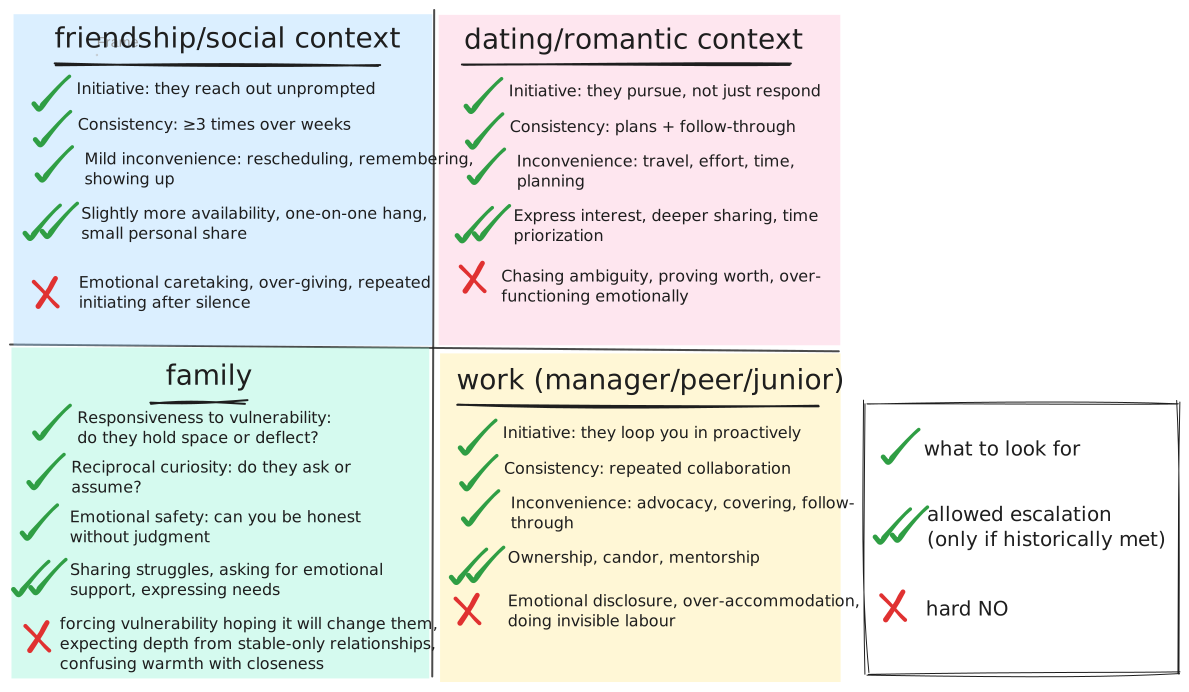
Here’s the important correction: stable ≠ cold. Stable relationships can still be warm, kind, and meaningful. They’re just low bandwidth emotionally. So the healthy stance is: “I appreciate the stability they offer, and I don’t ask them to meet needs they’re not built for.” This protects you from the cycle of expectation, disappointment, and resentment. “I don’t need my family to be something else for me to be whole.” This internal script releases a lot of pressure. It allows me to appreciate what they do provide—stability, presence, continuity—without resenting what they don’t.
Even with family, it is important to not escalate emotional vulnerability unless it has historically been met. What boundaries look like in practice: sharing life updates, logistics, neutral positives and not raw emotion, hopes that need attunement, unprocessed pain. Recognizing that family provides a structural baseline—stability, predictability, shared history, but may not provide emotional nourishment can pave the way towards setting boundaries without confrontation.
- “It’s fine, I’ve got it handled.”
- “Nothing much to report, but things are okay.”
- “I’m still figuring it out.” Warm. Closed. Safe. These phrases maintain connection without inviting intrusion. They signal that you’re fine, that you don’t need fixing, and that the relationship can continue on its existing terms.
Load-bearing shortcuts
Understanding the distinction between stability and depth allows you to map relationships more accurately. Here’s how different contexts require different escalation patterns:
The paradox of initiation
I said earlier that if everyone becomes cynical, connection collapses. Someone has to put the first foot forward. That’s still true. But here’s the distinction to remember: Hope is offering a door. Self-respect is not holding it open indefinitely. Putting the first foot forward is not wrong. It’s human. It’s generous. It’s how anything ever starts. The problem isn’t hope. The problem is hope without limits. The problem is continuing to invest emotional energy into relationships that don’t reciprocate, convincing yourself that “one more attempt” will be the one that works.
The correct posture (this is key):
- Be willing to initiate
- Be unwilling to carry alone
- Let go early, not bitterly
This way, you stay open, don’t burn out and don’t turn cynical Hope-driven escalation is valid—as long as it’s bounded. You express interest. They reveal fit. If the fit isn’t there, you acknowledge it cleanly and redirect your energy elsewhere. That’s not giving up on connection. That’s respecting both your energy and their constraints.
Performance announces itself, care doesn’t
The most striking lesson comes in understanding the difference between responding and performing. Most people, when provoked or challenged, default to performance. They want to land the perfect line, deliver the verbal knockout, or prove themselves. And most of the time, it backfires. There’s a subtle power in pausing. Five or seven seconds of silence may seem absurdly long, but it gives you room to occupy the space rather than react to it. Asking someone to repeat themselves is not just tactical. It’s a way to let them hear their own words, sometimes soften them, and inadvertently invite clarity.
Cold reads
Observing people without performing is where cold reading comes in. Cold reading isn’t about labeling someone or diagnosing them; it’s about noticing patterns, inferring constraints, and respecting the limits of what they’re willing to reveal. It’s diagnostic, not directive. The goal is to read tendencies relative to your own temperament, not to judge or prescribe behavior.
I learned this through small, accumulating observations. At a bar with a group, I heard a song I liked and noted it down, sharing it with a new connection. Later on, I heard the same music playing in the car. It was a small gesture, but it told me volumes. The new connection had listened, remembered, and acted on it (or the order of the song might have just coincided with that point in time LOL). It wasn’t performative social maintenance. It was specific, contextual, and responsive to something I had shared. What made it meaningful was the lack of announcement. The new connection didn’t say, “Hey, remember that song you liked? I downloaded it!” Or “I ordered that espresso martini for you because I knew you liked tiramisu!!!” The gesture spoke for itself. That’s the difference between performance and presence. Performance announces itself, demands acknowledgment. Presence simply exists. It shows up quietly and consistently. And that consistency, over time, is what builds trust.
Contrast that with another friend. I celebrated that friend’s birthday. Friend didn’t wish me on my birthday, which was surprising. The friendship had a lot of performative closeness language but not much movement. Said friend say things that signaled closeness, but the actions didn’t quite cut through. Over time, I realized I was over-sacrificing—not out of neediness, but out of hope and conscientiousness. I wanted the friendship to work, so I kept investing. But repeated non-reciprocation is a clear pattern. Eventually, I had to ask: Is this relationship emotionally nourishing, or just socially embedded?
These are the micro-signals that accumulate to define whether a connection is worth pursuing, holding neutral, or stepping back. Recognizing these patterns early allows you to allocate your emotional energy wisely. You stop draining yourself on relationships that offer belonging but not closeness, stability but not depth.
Understanding value systems and context
Cold reading also teaches us to notice value systems: security, autonomy, connection, competence, meaning, and status. People express these differently depending on temperament and context. Missing these levers can make a seemingly accurate surface read completely misleading.
I’ve learned to distinguish between different relationship layers. For example, one friend invites me to the yearly family gathering, which I appreciate. That’s social inclusion. It signals I’m part of the friend’s extended network. But social inclusion is not the same as depth. Being socially anchored is different from being emotionally nourished. Group chat wishes signal belonging but not closeness. That’s not a criticism, it’s a clarification. Knowing the difference helps me calibrate expectations and avoid conflating the two.
Family dynamics taught me the starkest version of this lesson. Family relationships are often stable but not close. You see each other regularly, maintain routines, share history—but emotional intimacy may be absent. I used to resent that gap, thinking something was wrong with me or with them. Over time, I realized: stability serves a function. It provides predictability, reduces chaos, and anchors your baseline. Closeness serves a different function—it provides emotional nourishment, vulnerability, and depth. You can have one without the other. Accepting that distinction allows you to engage without draining yourself emotionally or expecting something the relationship isn’t designed to provide.
Understanding when a friend’s gestures are performative versus genuinely attentive requires noticing consistency, sacrifice, and responsiveness over time. Sacrifice means: Does this person show up when it’s inconvenient? Socially inconvenient—like defending you in a group when the crowd leans the other way. Emotionally inconvenient—like holding space for you when they’re drained. Logistically inconvenient—like rearranging plans because something matters to you. Words are easy. Movement is hard. Effort is the diagnostic.
Questioning and deepening connections
Questions are the other half of social intelligence. Cold reads give insight and create intrigue; questions invite depth. Knowing which to deploy, when, and in what tone is a skill in itself. Early in an interaction, observation dominates. Later, once trust is established, questions deepen understanding. Pausing, asking “What am I missing?”, or quietly noticing patterns before responding keeps conversations alive without triggering defensiveness.
The challenge is knowing when to escalate and when to hold neutral. I used to overthink what to say, which caused me to stall. The fear of saying the wrong thing or coming across as too eager paralyzed me. Over time, I realized that the anxiety wasn’t about the words themselves, it was about control. I wanted to engineer the perfect outcome, and that’s an impossible standard. The solution wasn’t to script better openings or craft clever follow-ups. It was to shift from trying to impress to simply being present.
Going back to self-introductions at group meetings, the transparent approach of saying “I want to expand my social network” or “I’m here to make friends,” isn’t wrong, but it can signal neediness if delivered too early. Start by returning to the same meetups, letting familiarity build organically. Belonging is built from repeated neutrality, not repeated bravery. You don’t announce your intentions; you simply show up, observe, engage lightly, and let invitations emerge sideways. Over time, people notice you. They remember your name. They ask follow-up questions. That’s when depth becomes possible.
The same holds for exiting conversations cleanly. Simple, graceful exits: “I’m going to grab a drink, but it was great talking to you.” “I see someone I know over there. Let’s catch up later.” These aren’t dismissive. They’re neutral. They signal that you valued the interaction without overcommitting. And they leave space for future re-engagement without pressure.
Another realization: meetups are containers for repeated exposure, not friendship factories. You’re not going to walk out of a single event with a new best friend. But you might walk out with a few familiar faces, some shared context, and the possibility of future connection. That’s enough. Over time, those repeated neutral interactions accumulate into belonging. And from belonging, closeness can emerge, but only if the reciprocity is there.
Humor and callback techniques
Humor, especially callback humor, anchors interactions in shared experience. I once referenced a minor mishap from earlier in a conversation, and the resulting shared laughter created subtle intimacy. The callback signaled that I had been present, that I remembered, and that we shared a moment. It wasn’t loud or performative. It was a small nod, a recognition that we had context together. Overuse signals trying too hard. The beauty is in restraint. Well-placed callbacks signal attention and presence without performance. They work because they’re specific, contextual, and effortless. They say: “I was here. I noticed. I remember.” That kind of attention is rare, and it builds trust without demanding it.
Words without movement are atmosphere
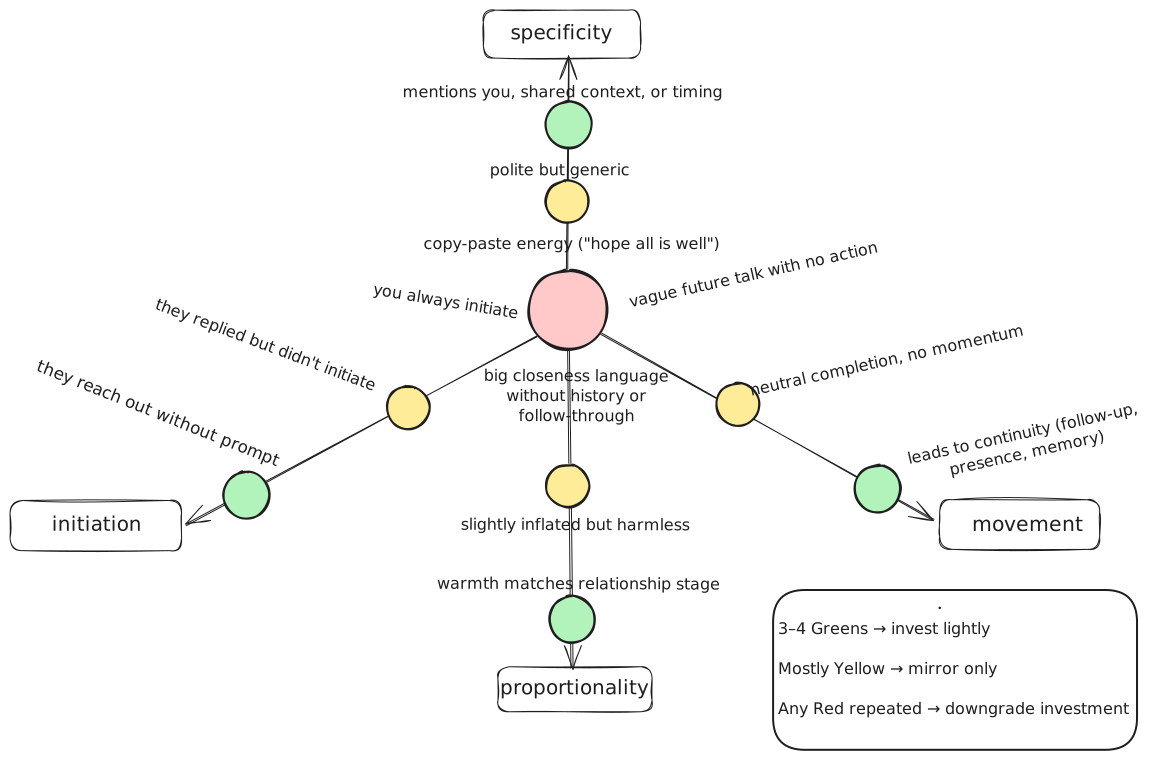
When you receive any message, silently score it on four dimensions. Don’t average them. One weak dimension already matters.
How to reply (this is where most people misstep)
Your goal: acknowledge without escalating. You don’t repay warmth with intensity. You repay it with clarity.
A. Replying to a GREEN message: “That’s really kind of you. I appreciate it.” Optional add-on (only if true): “Hope you’re doing well too.” Why this works: Confirms receipt. Matches warmth. Doesn’t inflate. Leaves door open. Do not add: Emotional disclosure, immediate plans, over-enthusiasm. Let repetition do the work.
B. Replying to a YELLOW message: “Thanks. Hope things are going well on your end.” That’s it. You’re not cold. You’re just not adding fuel.
C. Replying to performative closeness (hedging language) Example message: “You mean a lot to me, we should really catch up sometime!” Reply: “That’s kind of you. Hope you’re well.” Notice: Youacknowledge. You don’t echo. You don’t plan. Then you watch behavior. If nothing changes → downgrade.
The “What Changed?” Test (non-negotiable)
After any warm message, ask yourself: “What concrete thing changed after this?” Acceptable answers:
- They followed up
- They remembered later
- They showed up
- They initiated again
If the answer is “nothing” twice, stop investing.
Warmth without change = atmosphere, not structure.
Never upgrade a relationship based on words alone. Upgrade only when cost appears: time, effort, memory, adjustment. You don’t need a lot, just some. Words can create continuity but only actions create progression. That’s why: you acknowledge positive signs; you don’t upgrade the relationship yet; you watch for repetition.
This system does three things simultaneously:
- Prevents self-blame (“what’s wrong with me?”)
- Prevents over-giving
- Preserves openness for genuinely aligned people
When you feel tempted to invest more because something felt nice, say: “One clean signal is promising. Repetition decides.” That sentence keeps you grounded.
One of the trickiest dynamics involves boundaries with family. Family relationships often come with expectations: emotional labor, availability, deference. But those expectations don’t always align with what the relationship actually provides. Accepting stable relationships without expecting depth is a form of boundary-setting. It allows you to engage without resentment, to show up without draining yourself, and to maintain the relationship on terms that respect your temperament. Conflict is less about confrontation and more about alignment with constraints. Misunderstanding is less about miscommunication and more about ignoring context and energy.
Emotional clarity, steady baseline, reciprocity over performance, and being seen without being dissected are the patterns I’ve learned to prioritize. You don’t want people who perform for your approval or who demand that you perform for theirs. You want the ones whose presence is a constant, not a variable. The real question isn’t whether the exchange is perfectly balanced. The question is: Does this person show up when it matters? Do they remember? Do they invest effort without demanding a ledger?
Staying diagnostic, not prescriptive
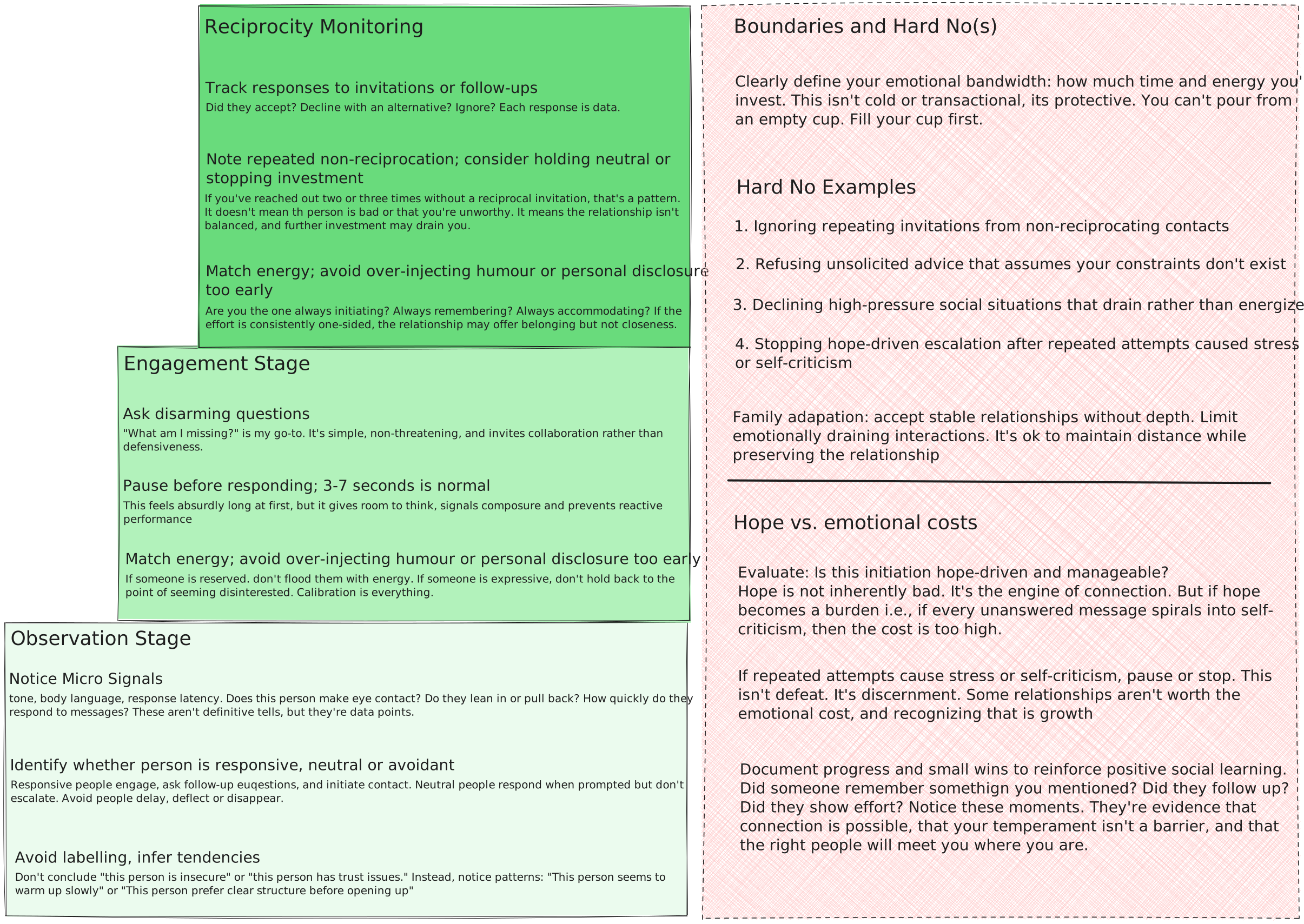
Hopefully, this field manual (of some sort?) help you to observe tendencies and patterns relative to your temperament, rather than judging yourself or others. The motivation here is to guide your attention, clarify your emotional bandwidth, and supports decisions about escalating, holding neutral, or stepping back.
This is not a scorecard. It is not a prescription. It is not a moral judgment. Use it to diagnose patterns, both in yourself and in the way others interact with you. The goal is not perfection; it’s discernment.
The real craft
Words, humor, questions, and reads are tools; the real craft lies in presence and discernment. Small acts of attention, subtle acknowledgment, curiosity that doesn’t overwhelm, and consistency in behavior—all speak louder than the most cleverly constructed sentence. Words are flexible, fleeting; effort and presence are durable. You can misstate something and recover if you’re anchored in awareness. You cannot fake sustained presence without being exposed eventually.
Practicing this requires patience. You observe patterns, note constraints, test cold reads lightly, deploy humor organically, and always stay present. Responding instead of performing becomes a habit over time, not a checklist. And the more you practice, the more natural it feels to walk into any interaction and know the levers at play without consciously thinking about them.
You don’t win by dominating, performing, or controlling. You win by noticing unseen currents, moving with awareness, and letting the conversation unfold on terms that balance honesty, curiosity, and respect.
Engineer lens: Growing as a better communicator
The lessons described here also map directly to professional growth as a software engineer. In fact, many of the same principles apply: noticing context, reading constraints, calibrating intervention, and balancing effort with awareness. Here are concrete, personalized ways I practice and continue to grow:
Regularly ask: “Is this the right problem to be solving?” This is the engineering equivalent of pausing before responding. It forces you to step back, question assumptions, and avoid reactive fixes that don’t address root causes. Just as in conversation, the most valuable intervention is often not the first one that comes to mind.
Write design memos or decision logs, even for small projects. This forces architectural thinking. It makes your reasoning visible, invites feedback, and creates a record you can revisit. It’s the professional version of noticing patterns and documenting them. Over time, these artifacts become a library of your thinking—proof that clarity and effort compound.
Teach a junior teammate. Teaching tests your ability to simplify without losing depth. It reveals gaps in your understanding and forces you to calibrate your explanation to someone else’s constraints. Just as in social interactions, the goal isn’t to impress, it’s to help someone else grow. That requires presence, patience, and the ability to meet them where they are.
When reviewing code or architecture, lead with why something matters before getting into how to fix it. This mirrors the disarming question technique. Instead of immediately correcting or judging, you explain context, motivation, and trade-offs. It builds trust, invites collaboration, and prevents defensiveness.
Create “guiding principles” documents that others can learn from. These are the professional equivalent of cold reads and value systems. They help your team understand the levers that matter: when to optimize for speed vs. maintainability, when to refactor vs. ship, when to debate vs. defer. Clear principles reduce ambiguity and align decision-making.
Resist the urge to fix everything yourself; coach instead. This is one of the hardest lessons. Just as over-sacrificing in relationships drains you, over-fixing in engineering prevents others from growing. Coaching is more scalable. It builds capacity. It respects constraints: yours and theirs.
Adopt a 1-hour prototype rule. Make something bad quickly, then iterate. This is the engineering version of “embrace progress over polish.” It prevents perfectionism from paralyzing you. It prioritizes movement over atmosphere. Prototypes are diagnostic—they reveal what works, what doesn’t, and what questions you haven’t asked yet.
Define non-negotiables; protect time for important work. Just as in relationships, bandwidth is finite. You can’t say yes to everything without burning out. Knowing what you’ll always make time for—deep work, learning, mentorship—allows you to say no cleanly to the rest.
Reflect weekly on energy flows. What energized you? What drained you? This is reciprocity monitoring for your professional life. If you’re consistently drained by meetings, low-leverage tasks, or misaligned priorities, that’s data. Adjust accordingly.
Practice “mirroring” in tough conversations. Repeat the emotional tone to show you understand. “It sounds like you’re frustrated by the lack of clarity here.” This signals presence, de-escalates tension, and invites collaboration. It’s the professional version of pausing and asking, “What am I missing?”
Journal moments of frustration to identify triggers, fears, and values. Frustration is diagnostic. It tells you what you care about, what constraints you’re bumping into, and what misalignments exist. Just as in relationships, noticing patterns is the first step toward calibration.
Use vulnerability in small, intentional doses to build trust. You don’t have to share everything, but when you do, make it count. “I’m still learning this.” “I made a mistake here.” “I don’t have all the answers.” Vulnerability is powerful because it’s rare, especially in technical fields. It signals honesty, invites reciprocity, and builds psychological safety.
Integrating these engineering-centered practices with social awareness reinforces a single principle: whether in code or conversation, clarity, presence, and calibration drive success. Your growth is iterative, measurable, and aligned with both your temperament and your context. You don’t have to become someone else. You adjust, notice, and calibrate. You lead with why. You protect bandwidth. You observe before concluding. You invest where there’s reciprocity. You hold neutral where there isn’t.
Where next
Temperament is not an optimization problem. It’s a constraint set. And constraints, properly understood, aren’t limitations, they’re design parameters. They tell you what kind of environment you thrive in, what kind of relationships nourish you, and what kind of interactions drain you. The goal isn’t to overcome your temperament. It’s to design a life that works within it. Effort matters more than words, presence more than performance, and calibration more than cleverness. I’ve learned to distinguish belonging from closeness, stability from depth, and performative language from genuine movement. I’ve learned when to escalate, when to hold neutral, and when to stop investing. I’ve learned that the people worth keeping respect boundaries, show up consistently, and respond to patterns rather than forcing alignment.
The prize isn’t victory. It’s clarity, safety, and trust. And those are built one small act of attention, one pause, one disarming question, one thoughtful gesture at a time. I say that’s a major win before the end of 2025. Merry christmas guys.